A meme sent to the Telegraph by one of its readers
Written by Harry Johnson
A new round of leaked statements have been made available to the Telegraph after the leaking of the government’s proposed Brexit strategy. Chief of them being leaks pertaining to the sacking of the former DEFRA secretary who has been expelled from cabinet after being accused of leaking from cabinet With these new leaks surfacing it appears that these accusations have been put in doubt as according to a member of government who has requested to remain anonymous no evidence has been provided to cabinet as of the time of writing this article.(M: as per request we are not posting minutes publicly ,but are willing to share them with quad if there is a need to verify)
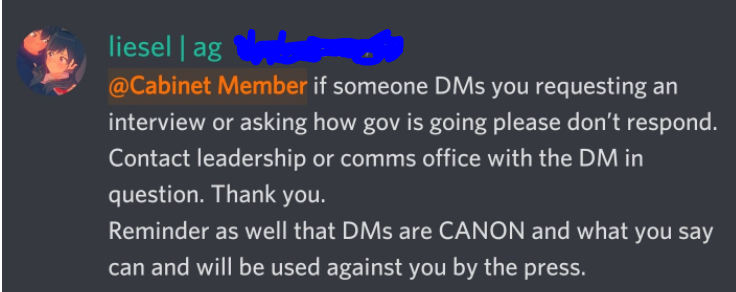
Moreover leaked minutes from a different source show that the government’s communications department has ordered a total radio silence due to fears of further leaks as shown by these minutes.
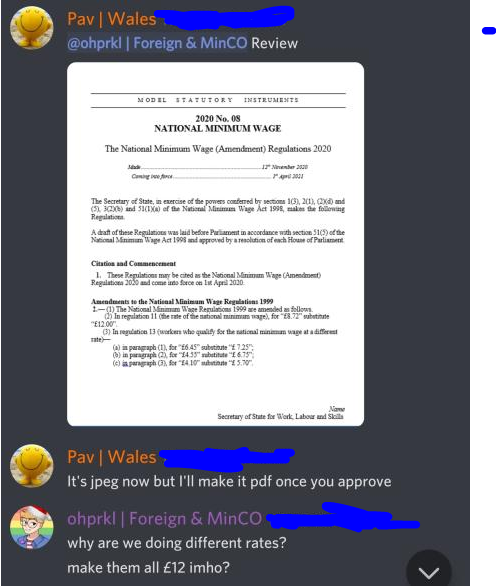
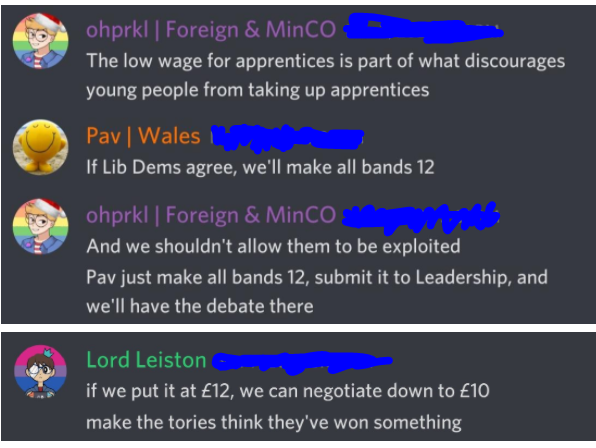
More interestingly leaks have also occurred regarding minimum wage as it appears that the government will raise the minimum wage to £12 despite Conservative objections to a lower rate under the Blurple government.
It is interesting to note that the government is avoiding internal debate ,opting to have the discussion on minimum wage within closed-off leadership channels. Ministers also propose negotiating with the Conservatives in bad faith in order to get the Tories to vote for something they had opposed under Blurple.
Judging by these newly released documents it appears as if the government is concerned about the growing backlash over leaked minutes. Moreover, the Telegraph is also aware of rumours that the investigation carried out by the Foreign and Northern Irish Secretaries found no conclusive evidence linking the DEFRA Secretary and that it is based upon potentially unreliable information from Libertarian members. Regardless of the validity of these rumors, it appears as if the Phoenix coalition may be far less stable than originally thought.
A rocky start to life for the Lab-Lib Government has hit another bump this evening, as questions to the Welsh Secretary and Welsh Government resulted in divergent claims from both parties over the status of Port Talbot talks. The fate of Port Talbot and the thousands of jobs have been in uncertainty as the region and factory face hard times. The Welsh government has long sought assistance from Westminster to save these jobs and support the local economy but relations between Wales and Westminster over the fate of Port Talbot and the extent of support have been strained.
In response to questions from Telegraph journalist Tres Commas, newly appointed Welsh Secretary NeatSaucer said that the government was “doing it’s level best to save all jobs at Port Talbot”. NeatSaucer also went on to say they were “in discussions at present” with the Welsh Gov, and that the Welsh Gov had been “co-operative”. He went on to say “We are discussing implementing the Unity Plan and exploring other solutions to save our workers, so yes.” The Unity plan refers to prospal to support Port Talbot which has yet to be approved by Parliament or the Welsh government as of yet.
Conversations between that Telegraph journalist and the First Minister of Wales SecretarySalami have placed the Welsh Secretary’s account into question however. The First Minister said that while the Secretary “contacted us to schedule a meeting”, no meeting had taken place. The First Minister was keen to praise the Welsh Unity Governments plans on Port Talbot, saying “it will go a long way in saving jobs in the area and at the steel mill”. When asked once more “Has there been any discussions concerning the unity plan between you and the new WM govt ?” The Secretary once again responded clearly saying “No not yet.”
This comes as another source of tension for the Phoenix government has just into the first few days of their tenure the government has run into troubles with leaks that put into question their Brexit strategy and direction for the government. Yesterday the Government expelled the former EFRA Secretary on grounds he was leaking sensitive government information. It has been stormy waters for the new government, with the Queen’s Speech still yet to be presented to the House.
The conflicting accounts from Cardiff Bay and Westminster are a fresh headache for Lily’s government, who have endured a subpar start to the government. NeatSaucer will likely now face further questions and scrutiny over his handling of talks between himself and Cardiff Bay.
The LabLib Coalition and the Welsh Government have been reached out to for comment. This post will be updated when comment is provided.
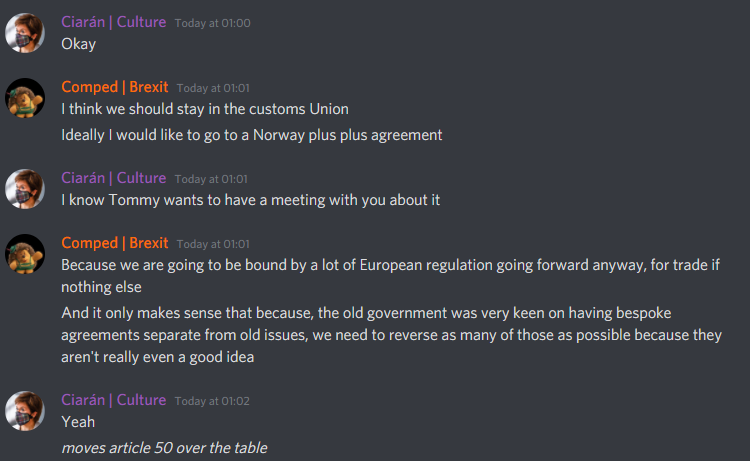
After receiving fierce criticism from the opposition due to a lack of a clear Brexit strategy it appears that the government’s Brexit strategy has at last surfaced with an anonymous source providing the details to the Telegraph. According to the comments made by the Brexit Secretary the government might override “multiple agreements with the European Union”, which may encompass areas such as aviation, the European arrest warrant and a slew of other agreements previously made by successive Conservative-lead governments.
The Telegraph believes that should the Minister’s plan come to fruition the United Kingdom could expect a much softer deal more akin to the current Status Quo. It is also possible that the government may elect to remain in the ECAA and thus maintain at least partial ECJ jurisdiction over the UK.
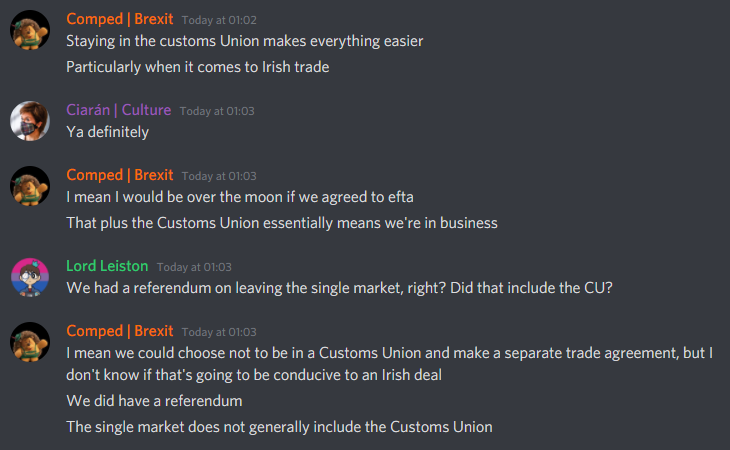
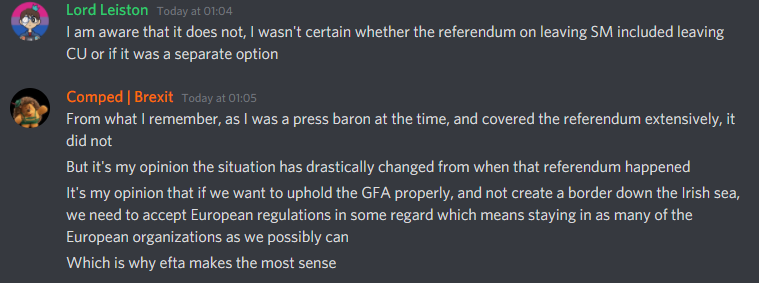
The Minister of State expresses his desire to stay in the customs union and ‘as many of the European organisations as we possibly can’
Most damningly however the leaked minutes indicate that the government may wish to stay in the European Customs Union and potentially in the single market as is prerequisite for a Norway plus deal proposed by the Minister. The Minister also made the claims that the UK should stay in as many EU institutions as possible and thus he preferred an EFTA or Norway deal. It is also unclear whether the government will keep the freedom of movement according to the leaked minutes.
However, given that the government has proposed to overturn points-based immigration and that any EFTA or Norway deal would most likely require Single Market membership it is highly likely that the government will indeed pursue freedom of movement.
According to the analysts at the Telegraph, it would be very difficult for the government to actually carry out such an agenda without seeking an additional extension, given the sheer volume of negotiations that would have to be redone. The Telegraph has also reached out to the Libertarian Party’s Spokesman for Trade for a comment on the issue:
“This is extremely worrying and frankly put frustrating for any Brexit ever regardless of the color of their tie. The British public has voted to leave the EU fully over 4 times now, twice in the Brexit and Single Market referendums. Yet what seems to be on offer from the government is a remain minus proposal that would keep us trapped in the EU without representation almost indefinitely. What shocks me the most however is the proposal to remain in the Customs Union.
Whether you want a soft or hard Brexit you should most definitely oppose this move. A customs union only deal will prevent Britain from forging new ambitious trade deals as we will still be bound to Brussel’s strict tariff policy. In the case of Turkey, this has effectively trapped them in a system where they have all the downsides of being in the EU with zero of the benefits. It’s a fool’s errand really. It is also questionable whether staying in the EU can safeguard the GFA any better than the current Irish protocol since the customs union does not guarantee free movement and thus would most likely require us to stay in the Single Market too in what is a remain minus deal that no-one has voted for
This shambles of a proposal only proves why we need the Brexit integrity bill on the floor pronto. This government is determined to take the easy way and squander the once in a lifetime opportunity to improve our position in the world with a poor deal’’
NeatSaucer recently wrote an article which made me chuckle and anyone who has been following politics would have been able to see the massive irony in their article.
They claimed:
We have promised to ink out deals with the United States, Japan and similar nations to ensure that as we are leaving the EU with a deal, we can have enhanced trading opportunities, strengthened global partnerships, and increased revenue. These are things which a Blurple Government cannot even in its wildest dreams provide for the people of the United Kingdom.
Let us remember it was the Conservative and Libertarians that saved Brexit from the disaster that was the Liberal alliance who was incompetent at negotating and embarrased the UK on the world stage. This is highly ironic coming from a government which contains the Liberal Democrats who botched negotiations leaving the Tories and Libertarians to save the day and secure a deal with the European Union. Blurple has a track record of delivering whereas Labour has a track record of trying to overturn democratic results and pushing for the debunked Ukraine model. The piece showed how of touch with politics the author was. The fact is Labour have never had a credible plan and at present do not have one. I highly doubt the UK will sign a US trade deal before the end of the implementation period due to the need for the government to focus energy on EU talks. The Libertarians absolutely back a trade deal with the United States and it is hard to take Labour seriously when they have espoused anti US trade deal rhetoric before. Furthermore they can’t even decide what their trade policy is. First they were for abolishing tariffs then against. Labour have no credibility on the matter of international trade.
When we first formed the Blurple government we have put forward a clear and concise vision for a Brexit. A blueprint on how to do it properly and in a manner that most if not all brexiteers can easily get behind. A comprehensive trade agreement with relevant provisions for other issues such as aviation, citizen’s rights, and other issues that would have to be inevitably settled by the 31st.
We built upon this progress in the second and third Blurple governments with the third government almost finalizing the deal to put the issue of Brexit once and for all. Not everything in life goes to plan and the coalition collapsed. Yet the progress made still remains, owing to the efforts of competent ministers like the Foreign and International Trade Secretaries. Two people, I had the immense pleasure of working with in my time as a cabinet secretary.
However, number 10 has a new occupant, a minority Labour-Liberal government that frankly has no clue what it is doing. All that we have heard from them is that they will pursue some sort of a deal by after the official deadline and even that came from a leak, not through official channels. We don’t know what sort of a deal the government wants, how will they solve the issue of Northern Ireland, or the degree of integration with the EU their deal would entail. All we know is that there might be a deal by the first and after that, it’s up to us to fill in the blanks. This is a stark contrast to Blurple where the framework for the EU-UK relationship has been public since July 2019.
This is especially dangerous because whenever uncertainty is introduced to the market chaos and instability. Moreover, no trade deal occurs in a vacuum, a deal we sign with the EU will inevitably impact our trade relationships elsewhere. For instance say the government botched the deal and breached the GFA. Not only would this directly impact Northern Ireland, but also impede a potential UK-US trade deal, due to the current makeup of US congress. This will be true no matter who occupies number 10 and through enhanced parliamentary scrutiny we can avoid such a nightmare scenario.
Glossing over the material issues related to such a strategy, is this really how we want our government to behave with the deadline creeping ever closer? The government is already yet to explain to the House why they wish to haphazardly neuter our force projection capabilities in the Indian Ocean and now they are leaving the House of Commons and more importantly the markets in the dark about one of the largest and most complex undertakings in our history. There is also no guarantee that there will be a majority for the government’s deal to pass unlike in the case of Blurple 3 where the government could expect to pass its deal easily. What happens then?
That is why it is crucial for the coalition to build upon the progress of the Blurple government’s strategy and consequently pursue a free trade agreement with no further EU integration beyond the barebones like the Irish protocol and ultimately why I and my party have felt obliged to table the Brexit integrity bill. We must ensure that Brexit is done on time and properly, lest we wish to risk another 2-page sunrise whitepaper…
Since we have moved away from a purely first past the post election system to a mixed-member proportional system it has become nigh impossible for a single party or at times groups of parties to secure a majority. Whether that is good or not is ultimately another argument worth its own discussion, but at the end of the day, we have a system that represents the wishes of the electorate quite well indeed.
A byproduct of such an arrangement is frequent minority governments. Governments with no majority or in other words capability to pass legislation through both Houses, which according to the pre-2014 mentality of British politics should not be or should be kept to the bare minimum. Yet normally this would not be a problem as more often than not some sort of a compromise can be hammered out between the big 4 parties as was the case when Blurple and Clegg governments managed to pass their budgets.
However, all of this ultimately hinges on middle ground existing. In the case of the Blurple budget, it was a common commitment to a dynamic market economy that brought the government and the Classical Liberals together. Under Clegg, it was quite frankly Labour selling its voters down the water, but the official reason is that Labour wanted to avoid the aforementioned Blurple budget from coming into force. Perhaps another good example of such consensus politics at work could be the Brexit government which saw multiple parties working together to get Brexit done despite their differences.
What happens however if this formula breaks down for one reason or another? Say a left-wing coalition of fewer than 40 seats found itself with the keys to number 10 despite a right-wing Parliament. There is not much common ground between either of the Blurple parties and the ultimately left-wing government, which has pledged to overturn many flagship Tory and Libertarian policies like the right to buy and TUBFRA. To add insult to injury many flagship policies of the Phoenix government are either physically impossible as is the case with the 2030 carbon neutrality deadline or too vague to be properly assessed.
Ultimately there is so much one can do through statutory instruments and royal prerogative ,which contrary to Solidarity’s belief is quite limited in scope. Any statutory instruments the government does indeed push through can be quite easily negated by a simple vote in Parliament or the case of most treaties indefinitely delayed thanks to the mechanisms of the Ponsonby convention. On the issue of a budget, the only shot the government would have at passing anything resembling a budget is if a deal could be struck with either of the Opposition parties, which is far from a safe bet considering how far ideologically apart the right and the government are.
Moreover, there have also been unconfirmed rumors that the coalition is yet to even formulate the composition of its cabinet and that no agenda has been properly discussed including the urgent issue of the Chagos Islands and the government’s apparent plan to withdraw from the islands entirely without talking to Parliament. We also still don’t know what sort of a Brexit deal the government has elected or will elect to pursue in the coming weeks and months.
Simply put the current government is not a Phoenix, but a headless chicken. A lame-duck with no majority nor the ability to pass most of its legislation. It is only a matter of time before the sun sets on the Phoenix just like it did with the Sunrise government before.
Recently, Labour Shadow EPW Secretary KalvinLokan penned an article on Northern England focused on how the North had seemingly been fooled by the center-right politicians from the LPUK and Conservatives. He claims that the people of the North “have found themselves subject to attacks [and] abandonment.” Going on, he then lays the main part of the blame for the continued existence of this inequality at the feet of the Tories and the LPUK because apparently despite many LPUK MPs being voted into Parliament to represent Northern constituencies with large majorities do not care about the people they represent.
The next part of his response seems to be firmly grounded in denial and disillusion because he reflects back on the “heavy damage” Labour took back in August. The General Election in August saw Labour take their most devastating loss in modern history as they were beaten by the LPUK to become the 2nd largest party in the Commons. Rather than taking the sensible approach for what might be behind the defeat like the fact the LPUK’s vision and message resonated with voters more than Labour’s manifesto which was riddled with typos, contradictory policies, and hordes of uncosted spending; Kalvin instead makes the decision for Northern voters saying they were fooled by “the parroting of lies” by the LPUK. This type of thinking indicates exactly why Labour has failed so horribly in the recent election because instead of taking their loss at the polls as a reflection of the changing wishes of the electorate, they instead choose to blame their defeat on the smooth-talking lies from the opposition.
Secondly, this mindset looks down on voters, especially on those in the North by saying that they are incapable of objectively analyzing party policies to decide what they want for themselves and if they choose to vote for the LPUK over Labour it must be because they were fooled by the LPUK’s lies and not due to Labour’s shortcomings in connecting with the public. More so, as an MP who personally represents part of the North, I must take offense at the statements made by KalvinLokan because I have done my best to represent the people of Manchester North. Let’s make clear that the inequalities that exist between the North and South have existed for centuries and were not simply created by the policies of the LPUK or the Tories. Furthermore, I would say the rise of the LPUK particularly in the North was fueled by the failure of the left. Why look at my seat Manchester North, which before my victory was a stronghold for the left, with the Green Party winning it in consecutive elections. It was the total failure of the Green Party and their fellow partners on the left which helped me win. Why the Green MP for Manchester North barely showed up to vote in the Commons and had one of the lowest voting turnout rates in Parliament. I can’t blame the people in my home for being frustrated with such terrible representation in Westminister.
Also when one looks at the facts we can see that the LPUK has undertaken specific policies to help the North which is probably the reason for our continued strong support in the North. The LPUK has continued to keep taxes low so ordinary working families in the North can keep more money in their pockets, we took action to combat homelessness, we committed to plans to combat the housing crisis in cities like Manchester. Overall instead of blaming the LPUK and the Tories for Labour’s defeat, I would urge KalvinLokan and his fellow Labour peers to take a hard look at their own policies. To end off, KalvinLokan claims “Any party could have achieved what pittance Thatcher did”, well if that’s true I wonder why Labour couldn’t win a majority to defeat Thatcher? Maybe they were also too busy like the current Labour leadership with blaming the right to take a critical and honest look at their own failures.
/u/ThreeCommasClub is the LPUK MP for Manchester North
It is not uncommon to see left-wing politicians act in an elitist and paternalist manner towards the people of Northern England. We have seen this sort of disdain and London-centrism during the Brexit and Single-Market referendums and it appears as if it is about to once again rear its ugly head as evidenced by the distasteful and misinformed comments of the Shadow EPW secretary.
`He claims that the Conservative and Libertarian parties act as some sort of an odd gatekeeper to prosperity, keeping the North in a state of permanent deprivation for some inexplicable ideological reason associated with Thatcherism and free-market economics. Nothing could be further from the truth however as the pronounced divide has existed in this country since at least the 1960s, with the trends in mortality showing a significant gap between the North and South under multiple Labour governments. However if one were to go with the flawed assumption that decreasing government spending and pursuing free-market policies equals greater north-south divide then Labour is arguably far worse as a Labour government would have instituted much stricter austerity during the Financial Crisis, to quote the then Labour Chancellor Alistair Darling “we will cut deeper than Thatcher ”. To try and spinLibertarian and Conservative positions as pro-divide or as the EPW secretary claims beyond levels of contempt held for the ordinary people of the North of England would imply that given Labour’s plans to impose massive cuts in 2010 Labour utterly despises the Northerners. However free trade and free-market policies quite arguably have the opposite effect as is the case with Blurple’s income tax reforms that saw those on the lowest incomes lifted. The same can be said for land-value taxation which arguably is in the interest of Northern areas as it redistributes wealth from wealthy southern areas to the North. Meanwhile, free trade deals and initiatives such as free ports can be used to funnel capital into the more deprived areas and consequently create thousands of well-paying jobs. The North quite frankly does not need a Labour government propping it up with a gargantuan deficit, it needs a pro-growth government to lift it and that is what center-right and right-wing parties have done for it. If anything it is Labour that is the anti-Northern party here with their support for the HS2 project which would heavily favour a few rich Southern areas at the expense of not only Northern England, but also Wales. One must also note that despite the North continuously returning pro-Brexit Conservative and Libertarian MPs Labour is the one faffing about its true Brexit position with the party bouncing in between different soft Brexit options contrary to the wishes of the Northern electorate. As reported by the Telegraph the coalition deal being pushed by Labour lacks any plan for Brexit whatsoever and could plunge the country into chaos. To add insult to injury the member also makes the inference that those in the North are stupid, claiming that to how the parroting of lies has held up the LPUK vote so well in these communities where the party’s “inspiration” was so able to destroy effectively and thoroughly in the 80s.” In other words, he seems to think that the Northerners are incapable of critically analyzing the Libertarian platform and thus are returning Libertarian MPs in droves because in his view they seem stupid enough to do so. This level of utter contempt for the people of Northern England is why Labour has lost the last General Election and why they will continue to lose until they realize that others may think differently to them are not being lied to or manipulated, but simply have different views..
In what will no doubt come as a blow to Labour, it seems that the Tories and Lib Dems have also negotiated a coalition agreement in direct opposition to the Phoenix agreement. This move will come as a departure from Prime Minister Brain’s earlier comments on the collapse of the Burple Government where he indicated that he would lead the Tories to the opposition benches and did not intent to actively seek government. It seems now that the Tories have reversed course and chosen to negotiate a deal with the Liberal Democrats. The Telegraph has secured an exclusive copy of the document and will be breaking it down.
Taken as a whole the coalition contains many similar policies compared to the Burple agreement and the original Tory-Lib Dem deal created at the start of this term. On the economy, the agreement promises to decrease LVT by 5% and freeze VAT. Income taxes are also slated to frozen not taking into account the planned NICphase-out. They also intend to separate the NIT from the personal allowance. In addition, while the agreement says the coalition government will heed the GDP to debt ratio the deal makes no concrete plans to cut the nation’s debt or limit new borrowing.
On foreign policy, the deal, for the most part, is boring with promises to work with the D12 to stand up to aggressive actors such as China. They also intend to look into Taiwan’s participation in organizations that dont require formal recognition of statehood and accept Japan into the Five Eyes. Perhaps the most interesting part of their foreign policy section is the noncommitment of any action on Chagos. In what will come as a low to more liberal Lib Dems the manifesto simply promises to review the situation in the Chagos Islands by 2036 effective washing all responsibility for the islands from the Clegg government and all but ensuring that no action will be taken at least in this term.
On defense, it seems that the Clegg government will hold course, committing to investing a further 11 billion pounds into the armed forces. Perhaps more interestingly is the policy to create an international treaty concerning cyber warfare in order to define and regulate the use of such attacks in the realm of cybersecurity. The deal also mentions talking with other NATO members to consider cyber-attacks part of Article 5 a move sure to heighten tensions with nations like Russia and China and call into question what defines an attack on the nation given that thousands of cyberattacks are carried by nations both in NATO and outside of it.
In the Department for Business, Digital, Energy, and Industry the deal promises continue to guard against security threats and continued to develop the skills wallet. The deal further promises government investment into 5G infrastructure but does not mention the Liberal Democrats Celluar Infasycture bill which aims to nationalize cell networks and increase investment of 5G tech to the tune of over 50 billion pounds. On the topic of international trade, the deal promise sot negotiates free trade deals with the European Union but has zero details on a Brexit deal or policy, perhaps hinting at the fact that they failed to reach a consensus on the issue.
On education, it seems that the Liberal Democrats have backtracked from several of their stances. The deal promises to continue streamlining Universal Childcare and support teachers. Most notably on education, the Liberal Democrats who were vocal on opposing the Burple government push for grammar schools seem to have retreated. Despite being first in line to oppose grammar schools, the Clegg government document promises to lift the restrictions on new grammar schools and seeks to promote school choice on if they wish to be an academy or LEA run. Moreso, failing schools will be encouraged to become academies according to the coalition document as well.
On the environment, it seems further concessions were made by the Liberal Democrats with the Clegg government promising a carbon-neutral date of 2050 far later than the date of 2030 or 35 that the Liberal Democrats had previously pushed for. They further will not support a ban on diesel cars until 2035 but will mandate carbon-neutral homes by 2028. The Clegg deal also plans to scrap fossil fuels subsides expect for heat rates. This section does not mention a ban on off-shore drilling or fracking leaving those two in uncertainty.
On transport, the government promises to not fund any more projects that are not sustainable. HS2 will continue ahead and the possibility of a Northern Powerhouse Railway shall be examined in what is sure to puzzle some observers. However, privatization of the rail sector is to steam ahead, with a planned runway expansion at Heathrow airport, with the possibility of more expansions at Gatwick.
Furthermore, the Clegg government plans to repeal the Direct Democracy Act in a move that is sure to opposed by the LPUK and Labour. With what seems to a sizable part of the Commons if not a majority opposing the repeal it seems such an effort will be vain and it will share the same fate of the previous B1102 which has already failed.
Regarding the composition of the cabinet, the split seems to be Burple but with the Tories taking more of the Grand 4 in the form of Foreign Secretary and with the addition of the Secretary for Intl Development which shall be held by the Liberal Democrats. Obviously, Brain will become Prime Minister and Lib Dem Leader shall be DPM. The Tories will take Home Secretary, Defense Secretary, Foreign Secretary, Intl Trade, Justice, Environment, and Transport. The Lib Dems will get the Exchequer, CMS, Education, Business and Energy, Wales, and Scotland. With a split of 20-10 for the Tories, it seems the Lib Dems got short-changed with regards to cabinet in terms of a sheer number of positions and the assignment of prominent roles.
Also of note is that while Lib DL NorthernWomble was a signatory to the Phoenix Deal, he is not signed off on the Clegg deal perhaps incitation of drift within the Liberal Democrats regarding this deal. Having seen the cabinet split, and concession made by the Liberal Democrats it seems to be seen if this deal will be passed by the Liberal Democrats. Overall for British politics, it shows that Tories don’t intend to sit out of government for the rest of the term making Labour leadership a bit nervous about the results of their own deal. The ball is now with the Liberal Democrats: which deal will they pick and are they internal drifts on the Clegg deal? The fate of the next government hangs in the balance.
Earlier today the Telegraph received the document claimed to be the policy document of the Phoenix Coalition. In this article Harry Johnson analyses this supposed blueprint for a centre-left minority and tries to figure out how much these 2 parties and one independent will be able to do.
First up are cabinet positions. The Great offices appear more or less evenly split with Labour taking on the nations Finances , Foreign Affairs and prime ministership whereas the LibDems get control of the Home Department.In regards to other spots Labour can be seen controlling most other major departments such as Justice and International Trade , with Defence being one of the notable exceptions going to the LibDems.It is also worth noting that the former DRF independent SammySnail is to receive the post of Northern Irish Secretary alongside the leadership of the House of Commons. All in all it appears to be a somewhat proportional split with the Great offices favouring Labour along the lines of the Clegg agreement.
A different interesting aspect is that the document contains the 4 principles of the government that read just like fundamentals of any coalition government. Nonetheless it is interesting that the coalition is willing to consider other perspectives. Perhaps it has dawned upon the leadership of both parties that most of their policies will have to be watered down in order to pander to the centre-right parties controlling the Commons?
Moving on it seems that the Treasury policies closely resemble those pushed by the Labour party during it’s utter defeat in the XIV general election with a 2.5% increase in overall rate in corporation tax alongside with an equal cut for SMes. What is also worth noting here is that an increase of personal allowance to £25 thousand and to create a medium bracket between the basic and higher rate presumably to fund the other tax cuts. Overall the economic policy of the coalition appears to be a continuation of “Clegg” policies with a centre-left twist to them.
A similar theme can be seen through the coalition’s proposed foreign policy that appears centered around the issue of Chagos Islands with little to no substance , barring a commitment to introduce Taiwan to international organisations and the government’s commitment to the 2022 Olympics boycott , despite previous LibDem objections. This is followed by the Home Office policies pledging to oppose facial recognition technology and ending or practically disabling points based migration through loosening it.
Both of these policies appear to be rather broad and ridiculous as facial recognition has been successfully used in personal electronics as a security measure and no replacement for points-based immmigration was presented in the document ,but alas the policies of the Phoenix coalition seemfar from definitive right now and it is possible that as time goes on the coalition will iron them out.
Most worrying however is the lack of details on the issue of Brexit. The document lacks any sort of specifics as to what deal will actually be pursued by the government beyond seeking trade deals with countries like the US and Japan. Furthermore the agreement pledges to secure a deal by January the first even though the implementation period ends on the 31st of December. One must also keep in mind that to actually ratify the governments deal all of the Eu27 countries will need days if not weeks to pass the deal through their legislatures and thus it’s impossible to just run the clock down ,unless the Phoenix government wishes to see a no-deal exit.
Most of the policies contained within the other departments such as health , business and HCLG appear to be rather tame centre-left policies aimed at swaying the more moderate elements of the Conservative party with the exceptions being the coalition’s wishes to raise the minimum wage to 12 pounds for all workers and to end the right to buy scheme entirely. On the business side the government in waiting also proposes to repeal the controversial TUBFRA Act alongside giving insolvent companies to restructure into worker cooperatives without a clear way to repay their debts.
The last interesting bit of policy within the Lab-Lib agreement is the proposal to introduce “norway-style” prisons where prisoners aren’t “closed off” and have “more freedoms and get jobs”. Whether such a policy will work will heavily depend on the actual implementation of it and thus it’s difficult to comment on it.
FInally of note is the whipping procedure which just like the principles at the beginning of the document seems to be quite conciliatory in nature with “collective leadership” being able to determine whether whips will affect all government MPs or just the specific parties. There is also a dispute resolution mechanism provided under which it will be up to “collective leadership” to resolve disputes between individuals in different parties. What this means in practice is to be seen especially should a major dispute arise within the government has occurred during the last coalition involving Labour and the Liberal Parties.
All in all it appears that while the Phoenix coalition may seem enticing to center-left voters , it’s policies are vague and should it form it will have a hard time getting any of its more left-wing proposal through a predominantly right-wing parliament.
Yesterday the Conservative Party pulled out of the “Blurple” coalition , collapsing the government. As Britain finds itself without a functional government many wonder what’s next in store for the United Kingdom as no clear replacement for the government seems to exist. In this aticle Telegraph’s Harry Johnson looks at the potential outcomes of the current coalition period.
Scenario one Labour-LD minority with support from minor parties
Perhaps the most likely of all scenarios as of the time of writing this article. The hypothetical government would find itself with 38 out of 100 seats alongside an additional 8 seats from potential allies including The Progressive Party , The People’s movement , Solidarity and 2 former DRF MPs who are currently a part of the Official opposition. The policies of such a government are difficult to predict as it would lack a majority in the House of Commons and thus it is highly likely it would have to compromise. A potential sticking point for such an administration could be securing a viable Brexit deal within just weeks of the deadline,unless it chose to continue the work of the current International Trade Secretary. A decision that my prove itself quite controversial with the members of both parties ,both of which have traditionally favoured a softer Brexit. It is however worth noting that the Conservative Party has declared its willingness to assist such a government on the issue of brexit.Moreover an even bigger headache for this government could be the passage of a budget as unless a Clegg-esque budget deal can be struck with the Tory party , a left-wing budget is doomed to fail.
All in all , while such a government would have a hard time getting anything done it appears to be the most likely option of potential coalitions.
Scenario two Conservative Minority / Clegg Coalition
While the Conservatives have publicly ruled out entering a government as of today. It perhaps still might be worth examining the possibility of such a government ,given the volatile situation in Westminster. A government consisting solely out of Conservative and UUP MPs would control roughly a third of seats in the House of Commons and could potentially count on the support of either liberal democrats or Libertarians in order to pass legislation and stave off any potential challenges from the Official opposition.
A potentially different scenario could perhaps be some deeper form of Conservative-LD cooperation , perhaps a return of the Clegg government. The Telegraph expects such a government to play out in a similar fashion to a Conservative minority albeit with more moderate policies and a far stronger position relative to the Opposition Parties.
In terms of policy one could expect a Conservative minority to pursue flagship Conservative policies such as reforms to the provision of childcare , increased defence spending and reforms to land value taxation. In other words it could be expected that a potential Conservative minority would pursue similar policies to those of the previous Conservative minority. A more interesting situation may occur on the benches opposite as both the Libertarian and labour Parties would be in contention for control of Millbank Tower under a Conservative minority scenario. It is however worth stressing that as of the writing of this article the Conservative have ruled out a return to goverment and thus it’s difficult to speculate about any particular details of such an arragement.
Scenario three Libertarian-lead minority
One of the less predictable of the 4 potential scenarios laid out here , an LPUK minority government could count on 23 out of 100 seats within the House of Commons , with potential support from the Conservatives. A Libertarian only government would likely find itself in a difficult situation ,given it’s relatively small numbers. In fact an LPUK only minority government would be smaller than even the Liberal Alliance government , making it the smallest of all post-simulated polling governments. However a Libertarian government would have the advantage of being a single-party government and could most if not all existing blurple policies ensuring a continuity of power. The probability of such a government is quite low however as the current Opposition consisting of former DRF MPs and the Labour is one seat larger than a libertarian minority and thus we believe that a sole Libertarian government is unlikely.
A Libertarian-lead government with a junior coalition partner may have a better chance. As of today however the Telegraph is unaware of any such potential partners.
Whichever of the 3 governments forms , none of them will possess a majority in the House of Commons and thus will be considered minority governments.The success of a minority government therefore hinges upon the cooperation with other parties in the House of Commons , which with the current parliamentary arithmetic appears difficult at best and nigh impossible at worst.
Perhaps a completely different scenario in this situation could be an early General Election. Such a scenario seems unlikely though as none of the major parties except the Libertarians would stand to gain from a snap election. Even if an election did occur and seats switched hands it is likely that Parliament would be even more fractured ,owing to new parties on both the left and right entering parliament.
Another potential wildcard could be the composition of the House of Lords ,which as of today heavily favours the British left with the outgoing goverment having 12 peers to the Opposition’s 8 alongisde some 27 members of the Unofficial Opposition. While these numbers are meaningless in regards to coalition fomration , a potentially hostile house of lords could spell the disaster for any of the centre-right goverments and could make life easier for LAB-LD.
No matter the outcome of the coalition formation however it is clear that British politics are more polarised than ever…










 Model Telegraph